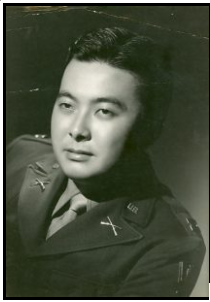
Seventeen year old Daniel Ken Inouye wanted to be a surgeon when he got older, so he worked for the Red Cross in High School. When he looked out his window on a clear December morning, and he watched planes with a red dot on the wing bomb Pearl Harbor, he ran to the Red Cross station to help. Even while running to help, he realized his life, and the lives of all Japanese Americans, was about to change. (1) Even though he was just 17 years old, he already knew how much his family had suffered by being Japanese in America. In 1922, two years before he was born, the Supreme Court ruled that not only could Japanese immigrants not be naturalized, but that anyone marrying a Japanese immigrant would lose their citizenship. Inouye knew his mother, a child of immigrants, had lost her citizenship by marrying his father, who had immigrated at 2 years old.(2)
As soon as he graduated, Inouye wanted to enlist. But the US Army didn’t want any of the Japanese- American volunteers at first. Since Japanese Americans weren’t put into concentration camps in Hawaii, Inouye continued to college. (1)
Eventually, Roosevelt had a change of heart. He opened the army to Japanese Americans, the children of immigrants, with the idea that “Americanism is a matter of mind and heart, it is not and has never been a matter of race or color,” Inouye quickly ran to join up, but was turned down, as studying to be a surgeon and working for the Red Cross were both good reasons for him to stay where he was. He was turned down. He immediately quit his job and dropped out of school, and when he went back, he was the second to last young man to be registered in the first batch of soldiers from Hawaii in the 442nd. (4) He was in an all Japanese American regiment, with all Caucasian officers. (1) His unit would end up being the most decorated unit for its size and length of service in the history of the US military. With a roster of about 18,000 men, the unit was awarded over 4,000 Purple Hearts, 4,000 Bronze Stars, 560 Silver Star Medals, 21 Medals of Honor, and seven Presidential Unit Citations. (5)
Because the 442nd was mainly filled with the children of Japanese immigrants, there wasn’t the normal moving in and out of soldiers. The 442nd became especially close, and the entire regiment adopted the Hawaiian recruits motto of ‘Go For Broke’. The Japanese American men also shared a strong desire to be courageous and not bring shame on their families. Inouye remembered his father’s parting words were ‘Whatever you do, don’t dishonor the country or dishonor the family’. (2)
Early on, Inouye was sent out with a squad to find a trail for the battalion to follow. Leading the battalion through, he made a wide bend instead of going through what looked like an easier path, and his colonel called him out on it. Inyoue answered, “Colonel, if you go further around the bend, there are several dozen dead, all lined up in all conditions, and I don’t think you want your men to pass by that and throw up and faint.” After that, the officer kept his eye on Inouye and sent him out more. (2)
Within a year, Inouye was made a sergeant and recognized as a sniper. His regiment was sent to France where they helped rescue the Texas National Guard which had been surrounded by German forces. That battle saw devastating losses overall and Inouye’s unit of 150 only had 42 men able to fight the next day. Inouye had been shot in the chest, but in a scene worthy of a movie, the bullet was deflected off his lucky silver dollars he kept in his shirt pocket. He was promoted to second lieutenant and received the Bronze Star. (1)
In April of 1945, Inouye lost his lucky silver dollar. This time a bullet struck his belly and went in. His soldiers tried to get him to get help, but he continued to advance on the German machine gunners, throwing grenades. He took out one nest with grenades, the second one with his submachine gun. He pulled the pin on another grenade, but as he raised his arm to throw it, a German rifle grenade pulverized his right elbow. Again, his men tried to help him, but this time he waved them back, afraid his now useless right hand would drop the grenade. Carefully, he used his left hand to undo the grenade, and threw it at the soldier who had shot him. Inouye continued to advance, using his left arm to fire his gun. He finally fell when struck in the leg with another bullet, crashing down into a ravine. (1)
He woke up as his men were dragging him away, and refused to be evacuated until his team’s objective was reached. He continued to direct his men from the sidelines, keeping them in defensive positions. Because of his tactics and leadership, his men were able to capture the ridge. (4). Nine hours after being wounded, he finally arrived at the field hospital. He would spend the next two years recuperating in various army hospitals, his dream of being a surgeon lost with his amputated right arm.
While he was in the hospital, he met another young man who had had his clavicle and part of his spine shattered by German fire in Italy, “a day apart and a mile apart”, losing complete use of his right hand. (7)The men bonded over their injuries, their war experiences, and their love of America. This other young soldier, Bob Dole, would convince Inouye that politics would be a good way to help people, even if he couldn’t be a surgeon anymore.
When Inouye was discharged from the army in 1947 as a captain, he reenrolled in college, this time majoring in government and economics. He got his law degree in 1952, and became one of Hawaii’s first representatives, and the first Japanese American. Dole was elected to congress a year later, and Inouye would joke ‘I went with the Dole plan, and I beat him.’(8) He became a senator in 1962, and spent a total of 53 years in the House and Senate. He worked tirelessly for the rights of indigenous people and people of color, including reparations for Japanese Americans held in internment camps during WWII. (9) He ended up the highest ranking Asian American in history, 3rd from the Presidency. (6)
In the late 1990s, the military reviewed cases of remarkable soldiers who may have been overlooked because of race. On June 21, 2000, Inouye and 19 other vets of his battalion were awarded the Medal of Honor by Clinton.
The hospital Dole and Inouye met is no longer a hospital. It is now named the Hart-Dole-Inouye Federal Center, for three of their patients who became senators.(4)
During Watergate, Inouye said to the youth of America, “Please stop telling me that you and I—that our nation—is doomed to eternal damnation. That the malaise which has been with us this past year is proof of our limitations. If it is proof of our limitations, our willingness and ability to do something about it is no less proof of our vital strength as a free people. If America can regain faith in herself, we can embark on our third century tempered by our mistakes, but enthusiastic about our future.” (7)
Longtime readers may remember another PYMNKA, Stanley Hayami, posted 11/29/2018. He was in the same segregated regiment and he was killed in the same battle Daniel almost died in.
People You May Not Know About But Probably Should has a facebook page you can follow:
People You May Not Know About But Probably Should now has a Substack you can follow.
If you want to buy the creator a coffee, you can do that at Ko-fi.
Sources and for more reading:
https://dkii.org is a site dedicated to his work.
(1) https://www.nationalww2museum.org/war/articles/medal-of-honor-recipient-daniel-inouye
(2) https://ddr.densho.org/media/ddr-densho-1000/ddr-densho-1000-28-transcript-18497c10fe.htm
(3) https://ddr.densho.org/media/ddr-densho-1000/ddr-densho-1000-28-transcript-18497c10fe.htm
(4) https://www.nps.gov/articles/inouyeww2.htm
(5) https://www.nationalww2museum.org/war/articles/442nd-regimental-combat-team
(6) https://dkii.org
(7) https://www.realclearbooks.com/articles/2024/09/06/celebrating_the_centennial_of_the_most_underappreciated_american_of_our_time_1056142.html?mc_cid=9bcddca2df&mc_eid=e392311f6f
(8) https://rollcall.com/2012/12/20/dole-has-one-last-moment-with-inouye/
(9)https://dkii.org/wp-content/uploads/LTCBARROS_SenInouye30NOV.pdf